Showing posts with label Thomas Paine. Show all posts

Saturday, February 28, 2015

New Brunswick's Guest House: maybe, maybe not.

When is a guest house not a guest house? When it’s the Guest House next to the New Brunswick Public Library.

You may have already guessed (no pun intended) that the house in question actually belonged to someone whose name was Guest. In this case, it was Henry Guest, one of the Hub City’s early prominent citizens.

The Guest House as it looked in 1938,
courtesy Historic American Buildings Survey.
Built in 1760, the 2.5 story, finely-cut stone house originally stood at the corner of Livingston Avenue and Carroll Place (now New Street). A city alderman, Guest seems to have been a very busy man with his hand in diverse industries. The stone for his house is said to have come from his quarry on Burnet Street, and he was also a whaler and tanner who developed new processes for treating leather. In fact, he claimed before the New York Society of the Arts that his specially-treated hides could be used for roofing in place of copper. Records of his claims against British raids show that he lost a substantial amount of hides and leather shoes to looting or burning in late 1776 or early 1777.

The Guest House, however, gets its greatest acclaim, ironically enough, from a guest who may or may not have stayed there for a short period during some of the darkest hours in early American history. Ardent patriots, the Guest family was friendly with notables including future President John Adams and pamphleteer Thomas Paine, and it’s said that Paine hid in the house for a short time in December 1776, as the British were making their charge across New Jersey. You might recall from a previous Hidden New Jersey entry that Paine was, at that point, writing The American Crisis, which inspired patriots when the Revolution seemed all but lost. No existing records indicate the exact dates when Paine was there, but a 1951 New Brunswick Sunday Times article theorizes it may have been early December, just before the city fell to the British.

Regardless of whether Paine took refuge there or not, the Guest House can claim some glory as home to Captain Moses Guest, who led the 1779 ambush and capture of Lieutenant Colonel John Graves Simcoe, Loyalist commander of the Queen’s Rangers.

Henry Guest reportedly said that if his descendants “would only keep a roof on it, the house would stand till Gabriel blew his trumpet.” However, the house itself very nearly became casualty, not to war, but to 20th century development. In 1925, the Livingston Avenue lot was purchased by the Elks as the site of their New Brunswick lodge. Pharmaceutical titan J. Seward Johnson saved the day, buying the house and offering it to the city, along with $50 in seed money for a fund to finance moving the house to another location and setting it on a new foundation.

Today, the Guest House tells its story in an understated fashion, sitting unobtrusively next to the library. Renovations in 1993 brought a new cedar shake roof, woodwork restorations on porch and portico and a new chimney. Under the care of the library administration, the house now hosts community meetings.

Sunday, August 12, 2012

History at every turn: strolling through Bordentown

Fresh off our Clara Barton discovery, Ivan and I drove to downtown Bordentown to see what other treasures were there for the finding. What we found was a quaint downtown, more of a 19th century feel than Burlington or Mount Holly, but still a throwback. Bank buildings were large and stately, the streets were wide and welcoming, and the architecture is Colonial with a mix of Classical and European influence.

Bordentown NJ
Some of the yards were fenced off with very cool wrought iron.
Oh, and there were some cute shops and eating places, too. It's a nice place to stroll and browse on a summer afternoon.

Important to us, sites of note were clearly marked. Bordentown is clearly proud of its heritage, both as a hub of transportation and as home to a cast of characters who might be considered rabblerousers of the Revolution. Starting in colonial times, the town's location made it a key spot for travelers between New York and Philadelphia, so it was a natural base of operations for revolutionary notables.

Since it's the kind of place where we could reasonably expect that the attractions listed in the WPA Guide to New Jersey still exist, I took it with me after we parked the car. I didn't want us to miss anything important. Within walking distance, we found a wealth of history:
  • Thomas Paine, the noted patriot and author of Common Sense, lived in Bordentown when he wasn't in France. You may recall that we first ran into his New Jersey exploits at New Bridge Landing, where Washington's 1776 retreat inspired Paine's classic, The American Crisis.
  • Francis Hopkinson house Bordentown NJ
    Francis Hopkinson's house.
  • Lawyer and artist Francis Hopkinson stayed in town after marrying the daughter of the man for whom Bordentown is named. Hopkinson not only signed the Declaration of Independence, but was a talented satirist and is credited with designing the New Jersey state seal. He's definitely a subject for a future Hidden New Jersey post, but for now we'll say that his poems and jingles inspired patriots both to fight for independence and to have a good laugh at British military.
  • The tracks of New Jersey's first railroad, the Camden and Amboy run on the bed of a sub-surface cut through downtown. Just a mile away, the state's first steam locomotive, the John Bull, was built and tested in 1831.
  • The Delaware and Raritan Canal's western end is at the base of a steep embankment just outside the business district.
  • The home of Patience Wright, who was America's first sculptress of note, well, when she wasn't spying for the colonists in London.
We also found a bit of fun in the shops around town. Crammed with all kinds of pop culture musts, Randy's Man Cave lacks for floor space to walk on, but more than makes up for it with Beavis and Butthead bobbleheads, loud music and Quisp cereal (really!). There was a bit too much Phillies memorabilia, but given the location, I guess that can be forgiven.

Point Breeze Bordentown NJ Bonaparte
Apparently the entrance to Bonaparte's estate.
We heeded the sign's direction.
The marquee explorer's site in Bordentown, of course, is Point Breeze, home of the exiled Joseph Bonaparte, King of Spain and Naples. Much of the site is overgrown and foreboding, with the remainder taken over by the Divine Word Seminary, so we left it unexplored, regrettably. Given the dense vegetation and the connection to noted ornithologist Charles Bonaparte, it would have been a kick to do some birding there.

Wednesday, February 29, 2012

The real George Washington Bridge... at New Bridge Landing

Totally exhausted from a long work week (Ivan) and a persistent head cold (me), we eschewed the usual wandering around this weekend for a more targeted trip. We'd driven through River Edge a few weeks ago, reminding me of New Bridge Landing and the Steuben House. I'd worked nearby for a stretch, and the small park there had been one of my favorite places to eat lunch on nice days. Besides the aforementioned house, a few other colonial-era buildings had been moved to the site on the banks of the Hackensack River, but I'd never been inside any of them. That was reason enough to check it out.

I thought I knew the story here: the house was once owned by loyalists named Zabriskie, and after the war, it was given to Major General Baron von Steuben, Inspector General of the Continental Army. That's all correct, but this is much more than a colonial house site. If you're to believe the signage that's gone up since my lunching visits, New Bridge Landing is the site of the real George Washington Bridge.

Today, the Hackensack barely flows past the Steuben house, having been impounded a few miles upstream to feed the Oradell Reservoir. At the time of the Revolution, though, the old Hacky was deep enough to supply a gristmill on site, supplemented by a nearby pool to make up for the effects of the river's tides. A wooden bridge there was the southernmost point at which the river could be crossed by man-made span, and commercial traffic took full advantage of the opportunity. The land surrounding the river farther downstream was even marshier than it is today, making it nearly impossible to build useful roads. If the muck didn't get you, the mosquitoes would.

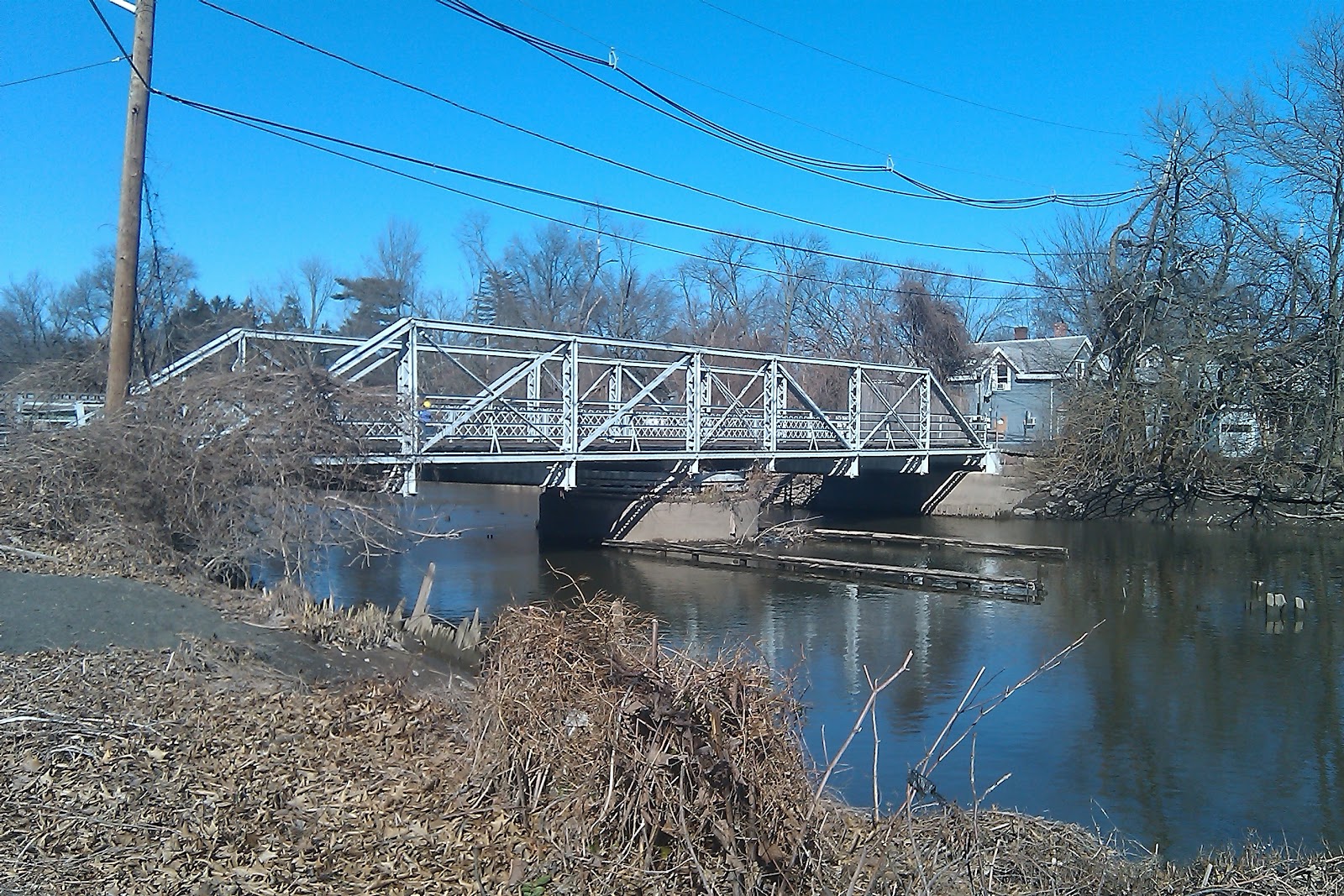
This steel swing bridge replaced the "Washington" bridge
in 1888 and is the oldest span of its type in New Jersey.
Knowing the local terrain meant the difference between survival and surrender for Washington's troops during some of the darkest days of the Revolutionary War. Cornwallis' British and Hessian troops crossed the Hudson in the early hours of November 20, 1776, with the goal of capturing Fort Lee (that's the actual fort, not the town we know today) and the nearly 1000 Continental soldiers garrisoned there. If the troops didn't move fast, they'd be trapped on the narrow peninsula between the Hudson and the Hackensack. And if the British got to New Bridge first, they'd not only be able to capture the Continentals, they'd have a strategic path to penetrate New Jersey and move westward into Pennsylvania without hindrance from the patriots.

Washington was already in the town of Hackensack and met his troops as they neared the crossing. Uncontested by the British, the men made it across the river, marched toward Hackensack and eventually made their way to Newark to recoup. It wasn't until the following day that Cornwallis' troops moved to capture the bridge, which they did successfully despite the efforts of the Continentals' rear guard.

Writer Thomas Paine was an eyewitness to the crossing and related the news in his tract The American Crisis, published about a month later. The decisive battles of Trenton and Princeton were yet to occur, and Paine was pretty much an embedded reporter in current day parlance. His opening words, "These are the times that try mens' souls" were written in New Jersey and still stir passion in the hearts of American patriots today.

Things are a lot more peaceful at New Bridge Landing now. Even though Route 4 and busy Hackensack Avenue aren't far away, you can conjure your own little calm by standing on the bridge and looking south. When we were there, the tide was out and Ivan noted that the mudflats would be great for shorebirds. We didn't see too much avian action but heard quite a bit of spring song in the air. A passive recreation park and greenway on the eastern side of the bridge offers even more opportunity to relax and get back to nature, even with houses across the quiet street.

The Bergen County Historical Society manages the Steuben House but hasn't held regular hours there since the property was flooded during a nor'easter in 2007. Their website has an exhaustive history of the property, along with relevant text from Paine's work.