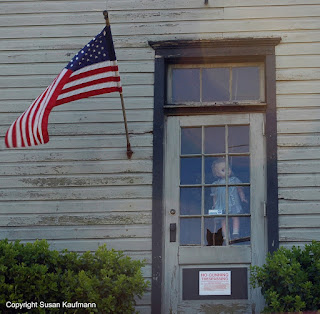
See, we'd gone there the day after one of this winter's rare snows, only to find we were barred from the area's chief birding spot because the road wasn't plowed properly. When we tried to find an alternate route, we ended up in the small village of Carpentersville, which appeared to be just a few houses and a couple of public buildings. I didn't think much of it until I looked up at the door to the one-room schoolhouse and saw a large doll just inside, hanging by its neck. That, plus the inordinately large number of POSTED and NO TRESPASSING signs got me thinking that perhaps it wasn't the friendliest place in the world. I took no pictures, though I was really tempted to.
Fast forward to yesterday. The weather was much nicer and I'd spent a total of 10 minutes at Motor Vehicle getting the biannual car inspection, so a road trip was in order. Maybe I could figure out the whole Carpentersville thing.
An hour and a few side trips later, I discovered the doll essentially hasn't moved since January, though there's now an unfriendly sign on the door, banning trespassing and gunning. (Gunning? You mean, using a gun, or revving an engine?). Check it out:

Well, I was there, so may as well do a little driving around. I hit a big "Do Not Enter" area farther down the road the hanging doll was on, so I made a right turn onto River Road. I found myself driving alongside a railroad track mounted on a berm. Several hundred yards down, the road split, the right side going to a gravel company and the left crossing the tracks and skirting toward the river. I went left.
For some crazy reason, it didn't occur to me that it was the Delaware I was seeing. I guess I'd lost my bearings once I left Route 78 and didn't realize how far west I'd gone. At that point, the river isn't anywhere near as wide as it is at the Water Gap, and the houses along the banks were pretty modest.
The train tracks still had me wondering, so I turned the car around and retraced my path in the hopes of discovering something, perhaps an old station. On a previous trip to Phillipsburg, we found a depot for the Belvidere and Delaware Railroad, which now offers occasional leisure rides along the river. Perhaps this was part of it?
River Road dutifully hugged the tracks, much as a tow path accompanies an old canal. Once I got past the little enclave where the hanging doll road intersects River Road, the pavement narrowed and fewer homes lined the way. Soon, the left side of the road was defined by craggy rock about 10 or 20 feet high, and the tracks to my right were looking less and less used. I passed a crew of two workers who appeared to be using picks to clear growth from around the tracks, but then... nothing. At points, the tracks were laid dangerously close to the river; I couldn't help but think that if they were used with any regularity, their owner would have shored them up more firmly. In fact, I have to believe that there's been significant erosion since they were first laid. Who'd take the chance a well-laden freight would tumble into the river?
 Not to worry: the road and tracks eventually intersected again, giving the rail route a comfortable distance from the banks. A little farther down and to my left, I saw a few old stone structures built into the hillside, looking very much like furnaces. Research later told me that locally quarried lime was processed here and then shipped out for use as fertilizer and an essential ingredient of cement. To me, however, they looked a lot more medieval, especially the less well-preserved ones. Perhaps someone was inside with a vat of boiling oil? Who knows. It seems to fit well with the slightly unfriendly vibe I felt back in town.
For some crazy reason, it didn't occur to me that it was the Delaware I was seeing. I guess I'd lost my bearings once I left Route 78 and didn't realize how far west I'd gone. At that point, the river isn't anywhere near as wide as it is at the Water Gap, and the houses along the banks were pretty modest.
The train tracks still had me wondering, so I turned the car around and retraced my path in the hopes of discovering something, perhaps an old station. On a previous trip to Phillipsburg, we found a depot for the Belvidere and Delaware Railroad, which now offers occasional leisure rides along the river. Perhaps this was part of it?
River Road dutifully hugged the tracks, much as a tow path accompanies an old canal. Once I got past the little enclave where the hanging doll road intersects River Road, the pavement narrowed and fewer homes lined the way. Soon, the left side of the road was defined by craggy rock about 10 or 20 feet high, and the tracks to my right were looking less and less used. I passed a crew of two workers who appeared to be using picks to clear growth from around the tracks, but then... nothing. At points, the tracks were laid dangerously close to the river; I couldn't help but think that if they were used with any regularity, their owner would have shored them up more firmly. In fact, I have to believe that there's been significant erosion since they were first laid. Who'd take the chance a well-laden freight would tumble into the river?
 Not to worry: the road and tracks eventually intersected again, giving the rail route a comfortable distance from the banks. A little farther down and to my left, I saw a few old stone structures built into the hillside, looking very much like furnaces. Research later told me that locally quarried lime was processed here and then shipped out for use as fertilizer and an essential ingredient of cement. To me, however, they looked a lot more medieval, especially the less well-preserved ones. Perhaps someone was inside with a vat of boiling oil? Who knows. It seems to fit well with the slightly unfriendly vibe I felt back in town.


